Why the outcomes drive the real value of AI
As AI spend keeps increasing, it’s tempting to look at it purely on the basis of cost per token or cost per seat. The real focus should be on outcomes.
AI is a tool your team is using to get more done faster or at least more efficiently. The results you get from using these tools are where the value lies. Without outcomes that meet your goals, the cost would be a drain on your business and cost per seat wouldn’t matter at all.
For teams that use AI, outcomes are reliant on the quality of the results they get. That quality relies entirely on improving organizational access to a knowledge base that can be relied on by every team using any AI tool.
With this in mind, there are two important questions that finance and procurement leaders should focus on besides the cost per token:
- Does the cost change how developers are working?
- What about our current workflows is holding teams back from improving AI output quality?
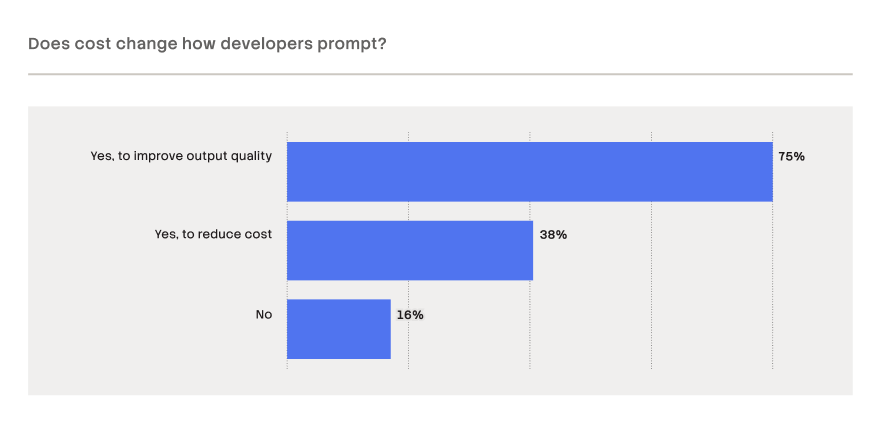
Most developers are working across multiple tools every week, including more than one AI tool. On top of that, the business tech stack keeps growing and changing.
Our survey shows that 19.7% of practitioners are using 1 tool, while the majority at nearly 75% are using between two and five different AI tools.
Teams need room to evolve their tech stack as needs and goals shift. When all of your team’s tools are sourcing answers from the same validated, permission-aware source of information, the specific AI tools used matters less. With context in place your team can use the AI they prefer and new tools are more easily adopted as needed.
The goal is ensuring that any technology you and your team use is context-aware enough to need fewer corrections because it has been provided with validated and current information from the start.
What to do next: focus on outcomes, not tokens. Retire usage as a success metric. Tokens consumed, prompts sent, and seats activated measure activity. Set goals on cycle time, correction and rework rates, search time saved, and incidents avoided.
Don’t tie performance reviews to AI usage. Measuring individuals on how much AI they use rewards volume over value and pushes developers to use AI where it doesn’t help. Measure team outcomes instead.
Forecast spend against outcomes. Pair usage limits with outcome reporting, so spend can increase where results justify it rather than being capped across the board.
Standardize the context layer. Keep the assistant and agent layer flexible, and make the shared knowledge layer the stable, governed foundation.