The content tax
If you ask a developer what slows them down the most, it isn't writing code. It’s the time it takes to track down the context they need to find the correct information when they notice an inaccurate AI response. This is the context tax that isn’t budgeted for. AI is supposed to save employees time, but for a lot of enterprise teams, the time they are losing because of unreliable AI results is spent tracking down verifiable information.
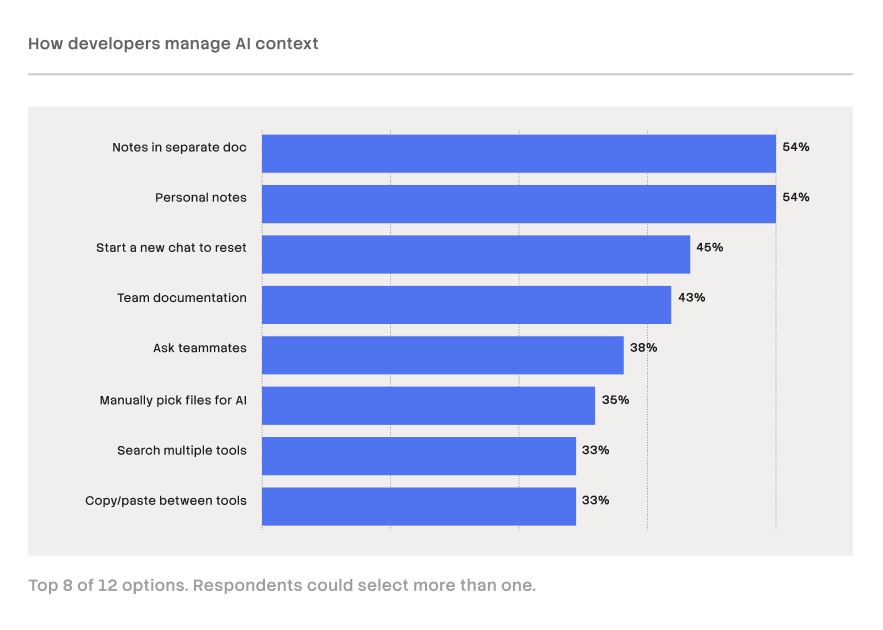
Context tax shows up in three places within a workflow: discoverability (can you find what you are looking for easily?), quality (is the information you find accurate?), and workflow integrations (does up-to-date information reach you, your agent, or where you are working when you need it?).
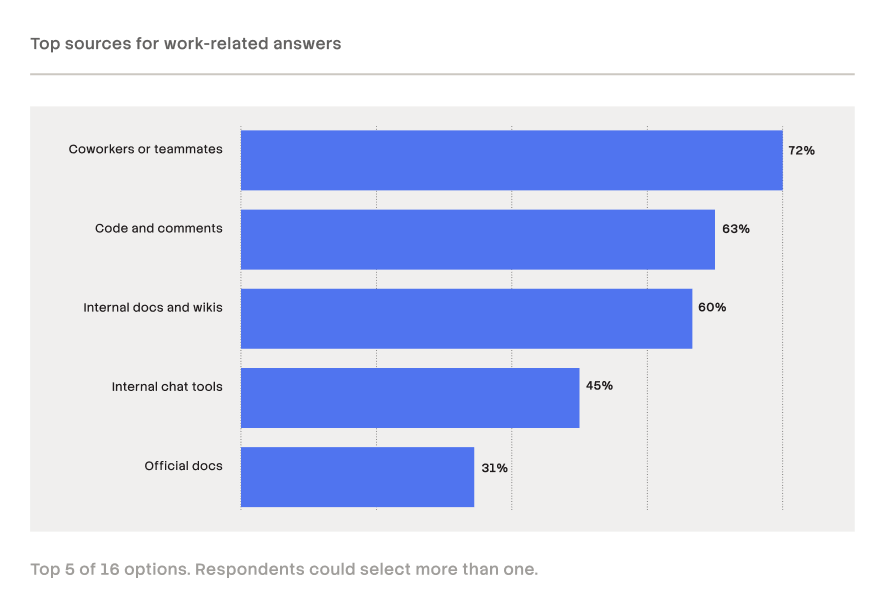
Consider the typical working day for a developer. They pick up a ticket that touches on a service they aren’t familiar with, so they search the company wiki and find two pieces of documentation that contradict one another. Then they find a chat from last year that references a design that is no longer current. So they ask an AI assistant and get an answer that was sourced from an outdated web page. They Slack a senior engineer to verify which piece of information is correct, but by the time they have an answer they can validate, half of their morning is gone. Even worse, none of this was captured anywhere, so another person will likely repeat this same process.
Developers still tend to find ways around blocks to be more efficient and use AI tools they trust more than others. This further suggests that a verifiable source of knowledge is the missing layer in most workflows.
Our survey shows that whether or not organizations maintain controls of AI for their teams varies widely. 24% of respondents say their organization provides AI tools and guidance, while 11% expect tools to be used for some tasks, and 10% measure AI use as part of performance reviews. On the other hand, 30% or organizations leave AI tool decisions up to individuals, 17.3% say different teams choose their own AI tools, 32.8% say their org uses a few approved tools, and 15% encourage AI use but don’t have consistent practices.
This shows that nearly half of developers work somewhere AI use is either left to individuals or encouraged without consistent practices in place. The best path forward to save time and standardize processes is to make sure the approved path is also the easiest to use. This means integrating shared organizational context that can be validated, kept current, and accessed by the teams and tools that need it.
For finance leaders, this is essential to understand: search-time savings is a leading metric that can be estimated but not easily tracked. When the time lost searching for missing context isn’t measured or at least acknowledged, it can’t be fixed. Once it is noticed, fixing it requires setting standards for what trusted context should look like, where it should be stored, and how it should be maintained going forward.
What to do next: make checking AI faster
Standardize context and use tools that integrate with what developers already use: Your AI toolset should work with what your team is already utilizing. Approve access to assistants and agents that integrate well, and invest in one governed source of organizational knowledge they all draw from.
Treat pilot cancellations as a sign that you need more company-specific knowledge: Before cancelling a pilot over quality, ask whether the tool had access to the organizational context it needed.