The verified context standard
79% of developers say that source attribution is important when trusting an AI answer. Further, developers tend to have confidence in knowledge sourced from colleagues the most. 72% say that coworkers are the most-used source for work related answers.
It’s clear that established relationships and successful track records are where workers place their trust when it comes to organizational knowledge. Information sourced from AI does not get this benefit of the doubt because, understandably, developers want to know where the AI sourced the answer from before relying on it. According to our survey, the top barriers to verifiable information are Incomplete info (63%), knowledge only living in people's heads (61%), and outdated information (56%).
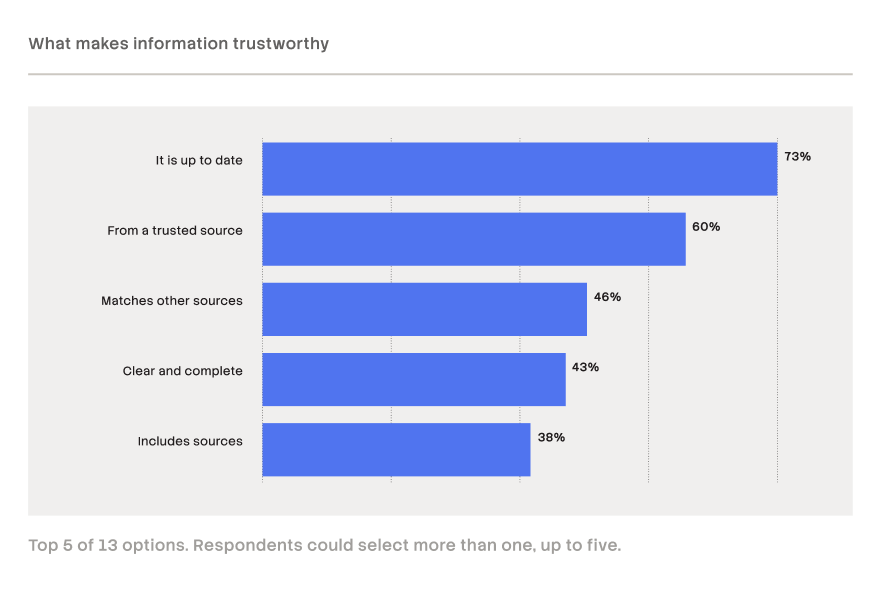
Five signals determine when information can be trusted:
Source visibility. Can I see where this came from?
Recency. Is it current or has it been replaced by something else?
Ownership. Do I know who created it or who is accountable for it?
Permissions. Am I, or is this agent, allowed to see and act on it?
Validation. Has someone with the right expertise confirmed it?
To meet this standard for humans and AI agents with consistency, more than a wiki is required. Creating an organizational context that will ultimately improve the quality of AI tool outputs is done in five phases.
- Capture. Pull knowledge from where work already happens (chat threads, tickets, wikis, repositories, and AI tools) and break it into reusable units, keeping each unit’s source attached.
- Validate. Attach trust signals to every response, such as authorship, recency, usage, and conflict detection, and route critical gaps or conflicts to the right subject matter expert. This is where a trusted knowledge layer and verified data come in.
- Organize. Scope knowledge to the right projects, teams, and agents so each sees what is relevant and nothing more.
- Govern. Manage permissions for people, teams, and agents centrally, with curation activity and audit trails.
- Deliver. Put validated knowledge into the tools developers already use, and into agents, through standard interfaces such as MCP and APIs.
This all matters because permissions and ownership are the biggest trust signals for practitioners, while also carrying extra weight for CISOs and compliance and risk leaders. When an agent acts on information or when an AI answer is integrated into a workflow, the team needs to be able to show where that information came from and who owns it. This will reduce the time spent verifying answers, which in turn makes teams more productive so they drive real outcomes for the business.
What to do next: build context, keep it current, and use it everywhere. Put search time on the budget. Estimate the hours your teams spend finding information each week and track that number over time. It is the clearest business-case metric for knowledge investment.
Capture knowledge where work happens. Don’t ask developers to write documentation in yet another tool. Capture decisions and answers from the chat, tickets, and repositories they already use.
Make visibility the default. Every answer a human or agent receives should have a clear path to track to a source, recency, owner, and validation status.
Connect practitioners to human subject matter experts. Route only real gaps and conflicts to subject matter experts, then capture their answer so it is asked once, not weekly.